Putting the Study in Study Abroad
What I've been learning!
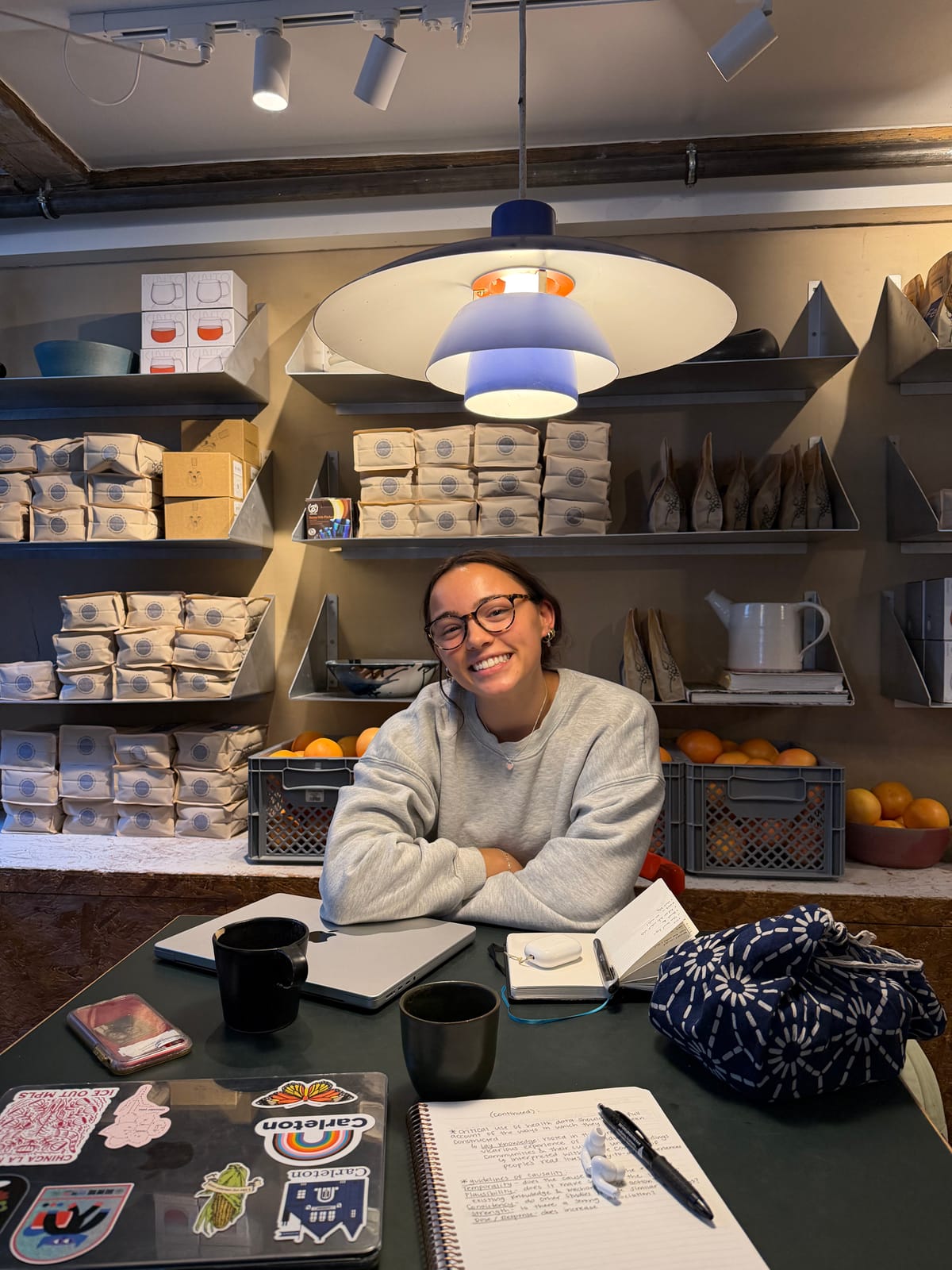
It's my seventh week of the term, which means I'm only a few weeks away from the halfway mark—crazy to say when I'm used to learning a semester's worth of content in ten weeks, starting midterm papers before I've barely had the chance to settle in, and, maybe the biggest change of all, no longer measuring time in weeks.
Instead, time passes in months. I'm just now getting started on semester-long projects and getting a sense for what I'm going to get out of each of my five classes. As an almost-middle-of-semester check-in, I thought I'd give an overview of what's been happening as of late.
Danish Language & Culture
We just wrapped up our first cultural assignment, which was group presentations about a national symbol of our choosing. Rather than picking something that was obviously symbolic of Danish culture, such as the flag, we were encouraged to think bigger, finding ways to show Danish nationality in different forms. Presentation topics ranged from the significance of smørrebrød, to Carlsberg beer (complete with Beer Trivia, with the winner receiving free beer), to the country's commitment to biking, to the symbol of water and canals. I learned lots! I did not win free beer.
Beyond that, we've talked a lot about the values of Denmark and the history that's occurred to make it to this point.
We've done the first three chapters of our language book, and are (supposed to be) able to have basic conversations in Danish. I know most of the phrases, just a little scared to use them out in the wild. I can introduce myself, tell you what I'm studying, what I'm doing this weekend, or how old I am. Certain words at the grocery store now look much more familiar, and I know some extremely important phrases (i.e. "må jeg bede en kop kaffe med maelk, uden sukker?")
Core Class: Comparative Healthcare Systems
So far, we've covered topics such as the basics of the welfare system, social trust, General Practitioners (GPs) and their role in gatekeeping, inequalities in healthcare, and prioritization. A big chunk of time has also been dedicated to working on our semester projects: any health topic of choice, as long as there is enough research out there to compare it between the US and Denmark. I'm still in the early stages of drafting, but I decided on health education, and more specifically, sexual health and awareness. If you want to know a few of the specifics I'm covering, read below.
It doesn't sit right with me that some people grow up receiving little to no education about their bodies, the changes that happen throughout adolescence and adulthood, and pregnancy. In the US, much of this education depends on the state or community where someone lives. Each state has its own regulations regarding what can and must be taught, while politics, religion, and cultural beliefs can also shape how sexual health is discussed. For example, students in a highly religious community may be taught that abstinence is the only acceptable form of sexual behavior, or that abortion is a sin rather than learning about it from a medical perspective. More conservative and liberal communities can also have very different approaches to topics like sex, birth control, and abortion.
This lack of consistent and accurate health education can have serious consequences. Young people may grow up without understanding how their bodies work, how to practice safe sex, or what birth control options are available. With more comprehensive, age-appropriate health education throughout people's lives, some of these gaps and poor health outcomes could potentially be prevented.
In Denmark, however, I don't see this issue in quite the same way. I don't yet know much about how the Danish system works, but I am interested in exploring how topics like sexual health and abortion are taught and addressed here. If I had to guess, topics like sex and abortion are much less political. Comparing Denmark and the US could provide an interesting look at how politics, culture, religion, and broader social values influence health education and sexual health policy.
Health Promotion and Disease Prevention
We talk a lot about public health frameworks, including the Social Ecological Model and social determinants of health. We also examine past and present public health campaigns, considering questions like: Are they effective? How is the message perceived by the people it's intended for? More broadly, we look at theories of disease prevention and epidemiology, focusing less on the scientific side and more on understanding public health from a general, community-based perspective. More assignments to come, although I couldn't tell you what they are yet.
Public Mental Health
This might be my favorite class. Engaging lectures, topics that are so incredibly applicable to real-world contexts, and good conversations. Part of the class is foundation-focused (more public health frameworks, psychopathology, epidemiology, etc.), but we also get to talk about a broad range of topics, including Social Emotional Learning (SEL) interventions, urban environments, global events & COVID-19, depression & anxiety, substance use & addiction, harm reduction, schizophrenia, and neurodiversity. Our prof is big on arts and crafts as well. Nothing like getting to cut and glue paper to show what I've been learning!
We haven't started our semester projects yet, but I do have a group. With a few of my classmates, we'll be looking into the "glass child" phenomenon, which basically explains the experiences of siblings and family members of someone struggling with mental health, substance abuse, chronic illness, etc. It can be an overlooked population—not a lot of research exists about the topic. We're curious if being the "glass child" and having these experiences results in the development of their own mental health struggles.
Health Beyond Borders
This is my global health class. If you consider many of the topics I've already discussed, this class is essentially the same content, but on a larger scale. We work a lot more with public policy: thinking about stakeholders, who has a seat at the table in these health-related discussions, and how health varies between locations. We discuss human rights, the UN's Sustainable Development Goals, the double burden of disease, and many other topics that you probably could assume (maternal & child health, gender, migration, and health economics).
There are three main projects for this class: the midterm, the final, and the country profile project. I haven't got a clue what the final will be, but I did have to submit my midterm paper a couple of weeks ago. I wrote an op-ed about period poverty and how government policies affect access to menstrual products in different countries. I mostly compare the U.S. and Denmark, arguing that while their tax systems are different, both can make period products harder to afford by treating them as discretionary rather than necessary expenses. If you ask me... they should be free.
For the country profile project, each of us got put into a group assigned a different country. In short, I'm doing a presentation and a report about the current state of health in Sierra Leone. It can include a variety of things, but it's essentially based on an overview of the country, health indicators, and other themes that are interesting about the country. For Sierra Leone, that means maternal mortality and FGM... (not the most cheerful, sorry).
And with that, (ESBPH) Eat Sleep Breathe Public Health 😚
Hope you're not bored out of your mind yet. Maybe you read this because you're curious about what I've been learning. If anything, it was helpful for me to write it out and get the tabs in my brain organized. Back to my regularly scheduled programming in a couple of days :)
Much Love!
Clara
p.s. Sorry for the lack of photos, I don't have much content from sitting in classrooms because it's boring.